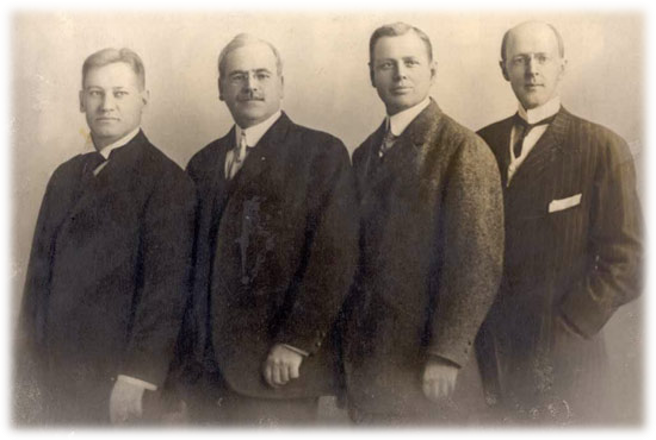
On February 23, 1905, the first four Rotarians (from left to right): Gustavus Loehr, Silvester Schiele, Hiram Shorey, and Paul Harris, met in Chicago for the first club meeting.
Rotary International: A Commitment to World Peace
Rotary International, founded on February 23, 1905, in Chicago, is a movement that brings together a select group of men and women from various professions and fields of activity who “put their skills and hearts at the service of others to promote understanding among people for a better future.” Its members uphold high standards of civic and professional ethics and develop programs dedicated to the public interest. Their main areas of focus include health and social welfare, sustainable development, education, training, and the personal growth of young generations within their communities.
At the founding of this institution, members took turns meeting in each other’s offices; it was during this period that the name “Rotary” was chosen and the Wheel emblem adopted. Rotary is the oldest international service club and one of the most widespread in the world: it is currently established in nearly 180 countries and regions, bringing together about 1.5 million members across more than 35,000 clubs in over 220 countries. These clubs are organized into districts, which are further grouped into zones. Each club holds a weekly meeting dedicated to discussing the projects it undertakes and pursuing the goals set for the year. Additionally, speakers are regularly invited to address topics related to various professional, economic, and social fields. Membership in Rotary follows the principle of co-optation, with new members being introduced by a sponsoring Rotarian. This process respects one of Rotary’s fundamental rules, which requires a balanced membership where no single profession dominates, ensuring the broadest possible representation of society.
Approximately 1,300 scholarships for higher education and vocational training.
More than 500 Group Study Exchanges.
Approximately 1,200 international humanitarian projects annually, supported through matching grants and 3-H projects (Health, Hunger, Humanity).
Grants for higher education professors wishing to teach abroad in a developing country.
Around 250 Rotary volunteers on missions abroad.
Meetings and initiatives within the framework of Rotary Peace Programs.
Purpose of Rotary
Rotary’s purpose is to encourage and cultivate the ideal of service, regarded as the foundation of all worthy enterprises, and more specifically, to encourage and cultivate:
Fellowship and Service
The development of personal friendships among its members, providing them with opportunities to serve the public good.
Professional Integrity
Adherence to the highest standards of honesty and courtesy in the practice of any profession, recognition of the dignity of all useful occupations, and the effort of each Rotarian to honor their profession and raise its standards in order to better serve society.
Service Above Self
The application by every Rotarian of the ideal of service in their personal, professional, and social life.
Global Understanding
Mutual understanding at the international level, goodwill, and respect for peace, by creating and maintaining cordial relationships worldwide among representatives of various professions, united by the ideal of service.
Created in 1917, 12 years after the birth of Rotary, under the leadership of RI President Arch Klumph, the Rotary Foundation embodies the motto “SERVE”. It grew from an initial contribution of US$26.5 million to reach nearly US$400 million in contributions for the 2019-2020 fiscal year. The Rotary Foundation is one of the world’s largest private foundations (NGOs) whose mission is to help Rotarians advance the goals of Rotary. It centralizes donations from Rotarians worldwide and from private entities that share Rotary’s vision, redistributing them through clearly defined programs developed at the initiative of the 35,000 Rotary Clubs.
Health improvement,
Support for Education
Eradication of Poverty
Environmental Protection
Its “PolioPlus” program, launched in 1985 with the World Health Organization (WHO) and to which it has already contributed over 2 billion dollars, has played a major role in vaccinating several billion children worldwide against poliomyelitis.